

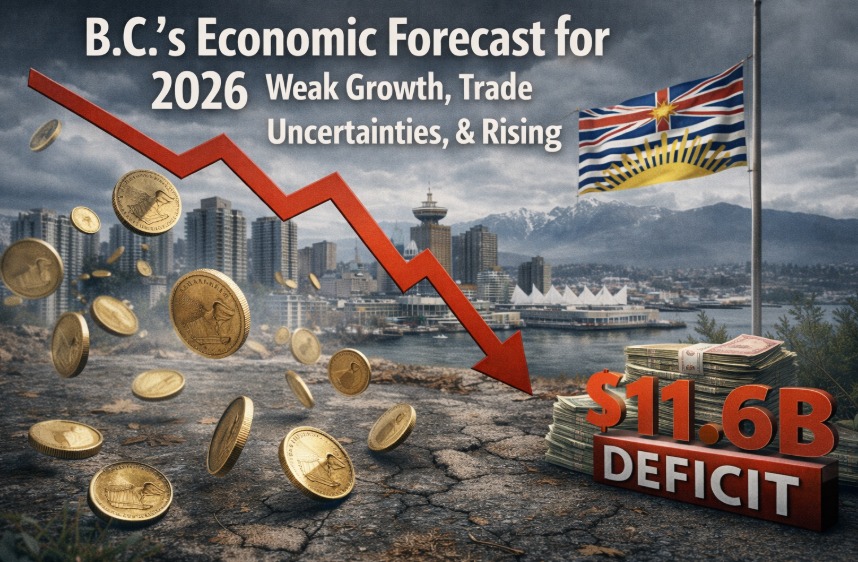
Weak Growth, Trade Tensions, and Rising Debt Cast a Long Shadow
British Columbia is heading into 2026 facing a challenging economic landscape, according to a new report from Deloitte. The firm’s latest forecast suggests the provincial economy will struggle to gain momentum in the year ahead, with growth expected to reach just 1.6 per cent, well below what is typically needed to meaningfully improve living standards or ease fiscal pressures.
Economists say the outlook reflects a combination of global uncertainty, strained trade relations with the United States, and long-standing structural issues at home. While there are a few bright spots offering modest relief, the overall picture points to a difficult year for businesses, workers, and governments alike.
Trade Uncertainty Looms Large
At the centre of Deloitte’s concerns is the impact of U.S.-imposed tariffs and ongoing uncertainty surrounding North American trade rules. Dawn Desjardins, Deloitte’s chief economist, says trade tensions remain the single biggest obstacle to stronger growth in British Columbia.
She notes that industries heavily exposed to U.S. markets—particularly forestry—are already feeling the strain. The upcoming review of the Canada–United States–Mexico Agreement (CUSMA) has added another layer of unpredictability, with no formal talks scheduled so far.
Desjardins warns that businesses are hesitant to invest when future market access is unclear. “That uncertainty is having a significant impact on the provincial economy,” she explains, adding that companies are waiting to see how trade rules evolve before committing capital to new projects.
Diversifying Trade and Cutting Red Tape
To reduce reliance on the U.S., Deloitte argues that both the province and the federal government must continue efforts to diversify trade relationships. That means forging new partnerships beyond North America and ensuring Canada’s ports and transportation networks can efficiently move goods to global markets.
However, Desjardins stresses that external diversification alone will not be enough. She says governments must also make it easier and faster for businesses to invest at home by cutting regulatory red tape and reducing interprovincial trade barriers.
Capital, she notes, is highly mobile in today’s economy. “Companies have the money, but they want to see returns quickly. If projects are delayed by regulation or uncertainty, that capital will simply go elsewhere.”
Investment at Home and Labour Shortages
Despite the push to expand global trade ties, Deloitte acknowledges that the U.S. will remain Canada’s largest trading partner for the foreseeable future. Geography and deeply integrated supply chains make a full pivot away from the American market unrealistic.
If trade relations fail to improve, Desjardins says Canada will need to lean more heavily on domestic investment. That includes boosting housing supply, protecting Canadian jobs, and supporting key industries through targeted federal funding.
Yet even these ambitions face constraints. Deloitte’s analysis suggests Canada is short roughly 500,000 workers nationwide, a labour gap that could limit the country’s ability to deliver major infrastructure, housing, and industrial projects. Addressing workforce shortages will require long-term planning, including immigration, training, and productivity improvements.
Pockets of Optimism Amid the Gloom
While the near-term outlook is subdued, Deloitte’s report does identify several factors that could help cushion the blow. One is the economic contribution from LNG Canada, which continues to provide investment and employment benefits, particularly in northern British Columbia.
Lower interest rates are another source of relief. With borrowing costs having come down significantly, households facing mortgage renewals may experience some easing of financial pressure. This could help stabilize consumer spending, which remains a key driver of the provincial economy.
Additionally, federal support for hard-hit sectors such as lumber and aluminum is expected to offer limited but meaningful assistance in 2026.
Rising Debt Adds to Fiscal Pressure
Despite these mitigating factors, Deloitte warns that British Columbia’s fiscal position remains a serious concern. The province recorded a record $11.6-billion deficit in the first quarter of the 2025–2026 fiscal year, driven in part by slower growth and policy changes such as the elimination of the carbon tax amid global trade uncertainty.
Rising debt levels reduce the government’s flexibility to respond to future shocks and could weigh on long-term economic prospects if left unaddressed.
A Difficult Year Ahead
In summary, Deloitte’s forecast paints a sobering picture of British Columbia’s economy as 2026 begins. Weak growth, fragile trade relations, labour shortages, and mounting debt all point to a year of hard choices for policymakers.
Still, Desjardins emphasizes that the challenges are not insurmountable. With sustained efforts to improve trade access, attract investment, and build workforce capacity, she says the province can begin laying the groundwork for stronger growth beyond 2026—even if the road ahead remains a difficult one.
